Sunday, 10 November 2013

Daliesque

We headed out of Lijiang, for the 6 hour drive south to Dali, with Sue starting to feel a little better, though still going nil by mouth and therefore a little weak. Dali was to be our base for 3 nights and we were looking forward to getting the chance to rest in 1 place awhile.

The scenery, which had been gradually changing as we had headed out of Scichuan into Yunnan was now markedly different. Most noticeably, it was overwhelmingly rural, with the land divided for cultivation into small strips, some no bigger than a cricket pitch in size (for Americans reading this, a cricket pitch is 22 yards long by about 10 feet wide; for Aussies, we will teach you how to use one shortly!). Maybe this is some sort of crop rotation strategy, but it felt more like a series of small-holdings. Either way, the land seemed really fertile on the valley floors, with a huge range of crops being grown. Rice is clearly the staple and most of the crop had fairly recently been harvested, with the stems being cut and arranged into neat sheaves. We played a game of naming the vegetables we could see growing: wheat, corn, cabbage, bok choi, onions, tomatoes, pumpkins, spinach, soya, chillies and garlic to name a few, with many more we didn't recognise. There were also lots of people out in the fields working, wearing their traditional conical hats, just as one would imagine. In places we saw fields being burned, a practice I can't remember seeing in the UK since I was a boy returning from summer holidays in the West Country.

The villages had also changed significantly. Gone were the ugly utilitarian grey high-rises, replaced by low-rise stone or concrete homes that were mostly immaculately white-washed and finished with intricate scenery paintings in hues of black and blue, reminding us of pen and ink drawings. It felt much more like the Chinese rural idyll that many of us on the truck had in our minds eyes.

We drove across these agricultural plains and then steadily ascended towards Dali, a city of 500,000 people, which sits at an elevation of some 1,600 metres, but surrounded by even higher mountains with the 20 kilometre long EnHai lake just to the east adding to its dramatic setting.

We arrived on a sunny afternoon and our spirits were immediately raised by the relaxed feel of our guest house: a 3 storey whitewashed building, with red pillars and black, grey and blue scenes and Chinese characters painted onto the walls in the local style. The guest house was built in a horshoe shape around a garden courtyard, with a bar, pool table and comfortable seating. The staff were smiling and attentive as we arrived and we all felt immediately at home here. Interestingly, we could see straight away that there were a lot more western faces here, such a contrast to our travels to date through Russia and China.

Our hostel was the project of an Australian and his Chinese wife who had settled here in Dali, as a half-way house between her home in north-eastern China and his home in Bribane. Appropriately enough, it was named the Jade Emu and it has proved so popular that they now have a second hostel just across the street called the Jade Roo and a bookshop and restaurant.

We later found that there is a thriving ex-pat community here in Dali, which centres in the area that we are staying and down the road in the Bad Monkey bar (more on that later). It never ceases to amaze the places that one finds such communities thriving.

That evening we went no further then the Jade Roo restaurant across the street, where they saved great Chinese - Western fusion food. We had some excitement, when the waiter arrived with some sizzling chicken that almost set the whole place alight. Sue reacted fastest (no pun on fasting intended!), leaping from her seat to blow out the flames before they took hold, whilst the rest of us looked on in stunned immobility. Poor Sue settled for some steamed rice and some crumbled dried seaweed (a wonder-food, packed with nutrients that we had recently discovered for all you foodies reading), but she would be back eating properly again the next day.

On our first full day in Dali, we jumped on a tour arranged by our hostel that circum-navigated Lake EnHai, following a road that has only been fairly recently completed. It turned out to be just Sue and I and a Tibetan guy of similar age to us who was on a 2 week holiday, touring Yunnan. The weather had turned grey and misty by this stage, which was a shame because on a clear day, the lake with the snow-capped mountains beyond it is meant to be a great sight. But it was an interesting day nonetheless. The villages by the side of the lake are populated mostly by the Bai people, who ethnically have more in common with Thais than Han Chinese. We were there on Saturday 26th October and in Xizhou, the first village we came to, there was a busy weekly open-air market going on, selling fruit and vegetables, fish and meat. On the edge of the market, they were killing, plucking and chopping chickens to order and pulling fish from improvised tanks for customers to take away still flapping. On the fringes of the village, corn hung out of the houses to dry, alongside chillies and rice husks on long tarpaulin sheets.

Our driver took us on to a batique factory showroom, clearly hoping that he would earn some commission, but we were put off somewhat by the conditions in the factory (see the picture below), though as this was on show, I guess these were probably better conditions than those that many of our clothes come from. As with the chickens and fish above and below, we westerners don't like our noses being rubbed in it I suppose - speak no evil, hear no evil!

Continuing our journey, we found cormorant fishermen waiting in boats by the side of the lake. We gather that this is the only place in the world where this is practiced, though it seems that nowadays it is pretty much only done for tourists. For $10 they will take you out onto the lake and demonstrate the art of cormorant fishing whilst they sing local folk songs at you through a megaphone. We politely declined, but viewed from the bank as they took another group of tourists out. It seems pretty barbaric, but we're told the cormorants are trained from an early age and get used to it: they are attached by rope to the boat and their throats are constricted so that they can't swallow a whole fish; when they dive and catch a fish, they are pulled back into the boat and the fish taken from them to be replaced with a much smaller morsel of fish as a 'reward'. By the side of the road, they were selling the fish that had been caught, most of which had been dried or smoked, or which were being cooked on charcoal grills. For the third time in the day, we weren't tempted!

Further round the lake, we stopped at a couple of remote temples, including one which involved being rowed a couple of hundred yards out to a small island by an ancient fisherman, in an even older boat. We admired his skillful oarsmaship whilst debating whether it would be better to swim to the island or back to the mainland when the boat sank, though remarkably we were brought safely back to shore. We were entranced back on the shore by a variety of birds we hadn't seen before: one of which we were told later was a Eurasian Spotted Hoopoe (see picture below).

The area as a whole remains fairly quiet, but now the road is completed the mass tourism will soon follow. We saw a number of large new hotels under construction as we drove. On the positive side, the road is lit by lamps that each have their own mini wind turbine and solar panel attached and this not only powers them but provides some power for the local villages as well. This was one of a few encouraging signs that we have seen of Chinese authorities taking renewable energy and environmental preservation seriously.

Back in Dali, after Sue had taken her first proper feed for a few days, I went out with a few of the guys from the truck to the Bad Monkey Bar. As you would expect from a bar in a small southern Chinese city, we found an Irishman and an American from Ohio up on stage strumming away on banjos playing Bluegrass! The Bad Monkey, it turns out, is owned by an Englishman from Essex and he also brews his own beer: including a very drinkable amber ale and a stronger porter. The bar was half filled with Chinese learning how to put their thumbs in their trousers and 'Yeehaa' like a Yankie and half with western ex-pats and travellers. We got chatting with the band (who are based in Kunming and make enough money to live playing in small bars); a retired Yorkshiremen who is John Hurt's doppelgänger and who had just returned from Kunming where he played a small part as Gandalf for a Chinese TV show and the owner of our guest house, who told us some of his story.

We spent our final day in Dali just ambling around the old city, doing some shopping and catching up on our admin back at the hostel. The city was very pleasant, with the biggest feature being that the old city walls have remained almost completely intact, including four elaborate entrance gates on the compass points.

On our next post we will update you on our journey south right down to the border to Laos, which would be our 9th country traversed on our journey to date.

There are lots of pictures to share with you here, as it was such an interesting few days.

Trying to sort out our bank in the garden of the Jade Emu in Dali

Locally sourced herbal remedies in Xizhou

The Saturday market in Xizhou

The wisdom of age

Ever wondered where your 'Made in China' garments come from?

Decorations to a Dali traditional home

Cormorant fishing on Lake EnHai

When the tourists aren't watching...

An Eurasian Hoopoe

The South Gate to the old city of Dali

The Bad Monkey, centre of Dali's western ex-pat community

And finally...our new candidate for the world's worst toilet - fortunately this time not connected to our hotel room!

And finally, finally...poodling along!


Friday, 8 November 2013

Lijiang and the Tiger Leaping Gorge

We left you last time with Sue having eaten a dodgy egg. Unfortunately we had some long drives to come as we headed further south in China, leaving Scichuan province for Yunan. On the 22nd and 23rd October, we had 2 full days of driving, with the plan being to bush camp on the first of those. By the end of the first day, Sue was starting to feel really unwell and coming down with a fever. The truck stopped at a pretty ropey place to set up camp (basically a small patch of land by the side of the road that had been earmarked for a new house) and I realised that Sue was not in a fit state for this. Jason, our Chinese guide, came into his own at this point and we manged to get a cab to take us to a nearby hotel for the night. I was pretty worried for a time, as Sue's temperature had risen to 39 degrees, but after applying some cold compresses it gradually started to come down.

The next morning we made the call that Sue was well enough to travel, and she was able to lie down on the back seat of the truck, but a long day was lengthened due to a motorway closure and we eventually limped into Lijiang after nearly 18 hours on the road. The only good thing to say about this, is that Sue was forced into going 'nil by mouth' for this period, which it turns out is exactly the correct treatment for Salmonella poisoning. Also we now had 3 nights in one place, which allowed her some time to recover.

Lijiang turned out to be a great city with some wonderful scenery around it, but sadly Sue missed out on it, pretty much staying in the room for the duration. This all sounds very gloomy, but the good news is that she is now recovered from this illness, as the photograph below proves!


So, let's tell you a little about Lijiang. The city is set in a large valley, surrounded by mountains and our time here was intended to be split between the two. We had a pleasant guest house on the edge of the old city (which was useful, because it allowed me to dip in and out, whilst keeping an eye on Sue). Whilst most people outside of China have probably not heard of Lijiang, Chinese people certainly have and parts of the old town are mobbed with Chinese tourists.
They come to see the maze of narrow cobbled streets and alleys, ramshackle old traditional wooden buildings (with some doorways giving tantalising glimpses of hidden courtyards beyond) and the streams and canals that run through the town, criss-crossed by old arched stone bridges. The narrow streets are lined with shops selling all manner of souvenirs (silk shawls, silver and jade jewellery, wooden carvings, paintings and calligraphy, bone handled combs, tea and all sorts of dried meats and foods). At one point I reached an area where the aroma of roasting meets started to fill the air. I followed my nose and the alley started to open into an area where it was lined on both sides by open counters grilling and frying skewers of meats of all descriptions. I couldn't even identify most of these (which was probably just as well, though we are reliably informed that dog and monkey meats attract premium rates), but I braved 3 skewers of pork and some stir fried vegetables and sat at a trestle table eating whilst trying unsuccessfully to make some sense of the chaos that surrounded me.

It occurred to me that we generally hate the word 'touristy' and you would have to apply that adjective to this place, but for a westerner here it felt wonderfully exotic. It also felt symbolic of the growing Chinese self-confidence. The Chinese people are more and more able to afford to take time out, to go out and explore their country and to spend money on indulging themselves. And here they were very content to do it in their own way and in their own style. I felt very much like I'd gate crashed a party which kept on rolling, pretty much oblivious to my presence and of the small sprinkling of other westerners in town.

As I headed back to the hotel, dusk was falling. In the main square, loud music was being played from ghetto blasters and 2 large concentric circles had been formed. People skipped around in time with the music, as if round a May-pole, breaking this pattern occasionally to bob their heads and throw their arms up in the air. Every face was grinning and it all looked like great, impromptu, slightly subversive fun!

The flower-shrouded entrance to Lijiang's old town.
A back street of Lijiang old town, with bars and restaurants lining a canal.

Throngs of Chinese tourists cram one of the alleys

What would you like on your skewer - yak or black goat?

On our second full day in Lijiang, Sue was well enough to stay at the hotel on her own, so I decided to go with most of the rest of the group on a day's hiking in the Tiger Leaping Gorge. After a 5.30 a.m. start, we drove for a couple of hours out of the city into the mountains, where the Jinsha Jiang river has cut a 10 mile, 200 metre deep gorge through the limestone.

It turned out to be a great, but challenging hike. From our base the path rose steadily initially through small villages, populated by the Naxi, a distinct minority ethnic group who live very simple lives, growing rice and vegetables and keeping pigs, chickens and other animals. The early morning mist gradually dispersed, revealing as it did the snow capped peaks of the Habe Shan mountains rising to 4,000 meters on the far side of the gorge. The sun transformed the fields into the brightest of greens, the river below us shimmered and our group was in the happiest of spirits.

Then the going got tough, as the path turned precipitously upwards, switch-backing straight up the mountain in a feature known locally as the 'Twenty Eight Bends', though we stopped counting when we got to 50. Occasionally we passed local Naxi villagers coming up and down with mules carrying their produce down to the road-head to get it to market, but only once did we meet other hikers. We passed an old lady by the side of the path at one point looking to sell some of her goods to us: 'Water?' No thanks; 'Snickers?' No thanks; 'Ganja?' Now she had our attention! It turns out this is one of their main cash crops in this remote mountain region and because they are a minority group the authorities turn a blind eye. We politely declined her offer, but she provided an amusing interlude.

We were heaving for beath and jelly-legged by the time we got to the top, but the views down over the gorge and across to the mountains beyond were truly worth the effort. We walked along the ridge for a couple of miles and then slowly descended down to the river floor through pine forest and small-scale farmland. At the the Tiger Leaping Gorge itself, a huge rock constricted the water, which crashed thunderously through the narrowed channel, filling the air with spray and blocking out any attempt at conversation.

Nearby we found a cluster of small guest houses by a quieter spot on the river floor for a late lunch and a rendezvous-virus with our transport to take us back to Lijiang.

On our next post, we will tell you about our onward journey south through the mountains of Yunnan to the ancient city of Dali.

The start of the walk, through a remote Naxi village
Our guide Gino and Driver Jim

Looking down onto the Tiger Leaping Gorge

A mountain village, home to the Naxi ethnic minority group
Looking back over the Gorge
And finally...asleep on the job?!


Friday, 1 November 2013

Holy Mountain Part Two

Everyone was looking forward to arriving in Emei Shan - one of the four holy mountains of China (Wudang Shan from our post 'Holy Mountain, Hidden Dragon' being one of the others). Emei, located in Sichuan province, is much higher than Wudang, with a peak of over 3,000 metres. It is also renowned as being one of the first areas where Buddhism was practiced in China (there are many temples to be found here, as well as some archaeological sites) and for a martial art that is only practiced here.

On arrival, we are delighted to find that we are staying for 2 nights in a very nice 4 star hotel, though this was counter-balanced by the weather, which had become colder, greyer and wetter as we approached the mountains. We were also disappointed that the entrance fees to the national park had been hiked, so that it word cost us over £100 if we wanted to go up to the summit. We begrudgingly accepted that it was not worth this investment, just to see a summit that was shrouded at that time in cloud and probably get a soaking in the bargain - though the 'inner optimist' kept asking what if the clouds were to clear or if, as very occasionally happens, the peak pokes above the clouds?

The ultimate way to see this place, is to hike up all the way from the bottom. This would probably take most of a week, but there are numerous monasteries on the way up who will, for a small contribution, provide a bed for a night and cook simple vegetarian meals.

We didn't have the time for this, but instead decided to just explore a little and turned right out of our hotel up the tree lined avenue that starts the road up towards the mountain. We were rewarded by a very pleasant series of surprises. The village of Emei Shan ended at a large square, bordered by the road on the right, a mountain stream on the left and ahead by a 40 foot high sheer rock face carved with jade and gold chinese characters and over which a curtain of water plunged to a pool below. The square was dominated by a golden pagoda whose centre-piece was a large bronze Ming Dynasty bell.

Having taken all of this in, we picked a small path that followed the stream uphill. It took us in short time up to a series of temples that documented the arrival (probably in the 1st Century AD) of a Buddhist prophet from India, who was seduced by the spiritual charms of the mountain and found an open-minded audience for his ideas here. Some of these temples had a very calm aura about them and we sat awhile letting this wash over us and looking at some of the beautiful carvings (see some in the pictures below). At the end of this series of temples, there was an archaeological site, where lots of ancient religious artefacts (and what looked like a mammoth tusk) were being uncovered.

The path continued uphill and we found ourselves in rainforest, thick with bamboo and all manner of other trees, vegetation, butterflies and birds. It was cool and peaceful, with the sole accompaniment of birdsong and the stream to our side. We walked uphill for a couple of hours, only occasionally passing local families out for a Sunday walk or to visit one of the many temples that we passed. We were on the look-out for macaque monkeys who are common at higher altitudes here, but didn't spot any (probably just as well, as they are renowned for attacking humans if they think they are carrying food!). It was altogether just what we needed and we came back down in good spirits.

A pagoda at Emei Shan, housing a Ming Dynasty bell

Sue in contemplation at the waterfall in Emei Shan village

A temple paying homage to the foundation of Buddhism in Emei Shan in the 1st Century AD

An atmospheric depiction of the early Buddhist disciples
 
A bronze demonstration of the local martial art form
One of many stone bridges that crossed the mountain streams at Emei Shan
Can anyone name this butterfly spotted on the lower slopes of the mountain?
Unfortunately Sue was about to go into a nightmare week. On the way down we stopped for some food at one of the local restaurants. We had a mix up with the food order and Sue got served egg, fried with rice noodles and we believe it was from this that she contracted Salmonella poisoning, which left her quite poorly for the next week, in turn made worse by the fact that we had some long drives in that time. Thankfully she is pretty much over that as I write this.
We will tell you more about the next instalments of our journey through China in the next posts, but I will just finish with my Night at the Chinese opera. Sue opted for an early night, as she (correctly) suspected that it might be very loud. Most of the rest of the group joined me and it was very enjoyable, if not quite what we expected. We assumed that we were heading to a low-key demonstration of Chinese opera for tourists, but found ourselves in a large modern theatre auditorium, filled exclusively with Chinese people, with a high-tech audio visual show incorporating piped music, acrobatics, puppetry and a story line which we struggled to follow, though an excitable lady from Singapore sat next to me gave me a running commentary throughout. As we arrived I said Ni Hao to her (one of the four or five words that I have now mastered and meaning 'Hello'). She looked at me with incredulity and said in perfect English 'You speak Mandarin?!'.
 
The finale of the Chinese opera / dance show


And finally...The Chinese Three Degrees


Monday, 28 October 2013

Bamboo Heaven

We promised you pandas, so here they are!

Hello, my name is Wen Li

Eats shoots, and leaves!
Sometimes it's just all too much...
The morning after the night before?

New-born pandas

A red panda

On Saturday 19th October, we got an early start from Chengdu to make sure we got to the Giant Panda Breeding Centre before all of the tourist buses. This plan worked pretty well, as we were indeed amongst the first people there. This is easily the largest and most important panda breeding and scientific research centre in the world. We confess to a little cynicism at the start: is the huge investment in pandas worthwhile, for an animal that seems to be so lacking in adaptability and apparently so lacking in instinct to procreate? Would all this fuss exist if pandas didn't have the 'cute, cuddly' factor? Could we not get a better environmental 'bang for our buck' in other less glamorous areas?

Our heads were turned a little, however, when we were told that pandas pre-exist humans on this earth and that they had proved themselves perfectly able to survive until humans came along and started to destroy their natural habitats, particularly in recent years. Then, of course, the 'cute, cuddly' factor is hard to resist.

In some ways the Chengdu centre is not much more than a zoo, but there is a lot more going on than this under the surface. First of all, the whole site has become a sort of nature reserve, recreating the pandas natural habitat and this has attracted lots more bird and animal life. Did you know that there are over 100 types of bamboo? We didn't, but apparently they are pretty much all to be found here. The center-piece of the site is a lake that is stocked with carp and other fish and black and white swans. Here we found a great 'natural adaptation' story. The black swans get a lot of tourist attention, or in other words they get fed a lot. The carp have sussed this out and you couldn't see a black swan without an attendant entourage of carp waiting to pounce on any scraps!

Carp follow the black swans around waiting for scraps from their table!

But back to the pandas. The site is paid for by the volume of tourists (both western and Chinese - we saw many more western faces here then we have seen for a long time) and fees earned from 'loaning' pandas to zoos around the world. Apparently every panda in the world is technically owned by the Chinese government.

We arrived in the middle of birthing season and there are dozens born here each year between August and October. We were able to go through the panda incubator, where we saw about a dozen cubs that have all been born this year. There are over 50 pandas here in total and, though they are kept in pens, they have a fair bit of space to roam in and all seemed in good condition.

After 3 hours at the site, we headed on towards the town of Leshan, which had attracted our attention when we were working on our itinerary. Leshan stands at the confluence of 3 rivers, but is now famous partly due to the efforts of the Taliban in Afghanistan. About 10 years ago they destroyed the largest Buddha in the world, thereby passing that title on to the Dafo Buddha in Leshan. He was carved into the rock-face by the water's edge some 1,200 years ago to protect fisherman from the dangerous waters created by the merging rivers. At more than 70 metres high and with and a 28 metre shoulder, he sits proudly looking down on the river, hands camly resting on his knees. We didn't really have time to do him justice, so to avoid the queues to get right up to him (see the people coming down the stairs to his left in the photo below), we took a ferry across the river that provided great views and perspective and went slowly enough past to get some good photos.

The town itself is also very pleasant and we spent a short time walking along the river where there were some beautiful rock carvings that seemed to go almost unnoticed next to the bigger draw of the Buddha. Back at the truck, we found a game of football going on around the truck, with some of our guys against some locals, which had started to have attracted almost as big a crowd as the Buddha!


The girls on our group pose in front of the Dafu Buddha

Back on board again and we had another couple of hours drive to get to our next stop of Emei Shan, one of China's 4 holiest mountains. We will tell you more about that in our next post, but just to say that we had a great surprise of a modern, stylish 4 star hotel for our 2 night stay.

And finally....we've been thinking just this, but haven't been able to put it so politely!


Sunday, 27 October 2013

A Birthday on the road

We left you in the last post rather bedraggled on a rainy Wanzhou pier on the banks of the Yangtse. Archie was waiting faithfully for us nearby and we were quickly back on the road again. We were heading west now, with a 5 hour drive to the town of Dazu, in the steady rain. This apart, the drive was pretty uneventful, but after the awful accomodation on the riverboat, we were relieved to find that we were staying in a very nice hotel for the evening. Doubly so, because the next morning was Sue's birthday - and nobody wants to wake up somewhere grotty on their birthday!

On the morning of Sue's birthday, we were treated to a traditional Chinese breakfas buffet, which included: roasted peanuts, finely sliced pickled peppers, cabbage and chillies, giant fluffy rice dumplings, an odd tasting sponge cake (no candles!) and buck wheat tea (an acquired taste). To most people, rising at 7.00 to eat such fare might not be the ideal start to their birthday, but strangely we both really enjoyed it.

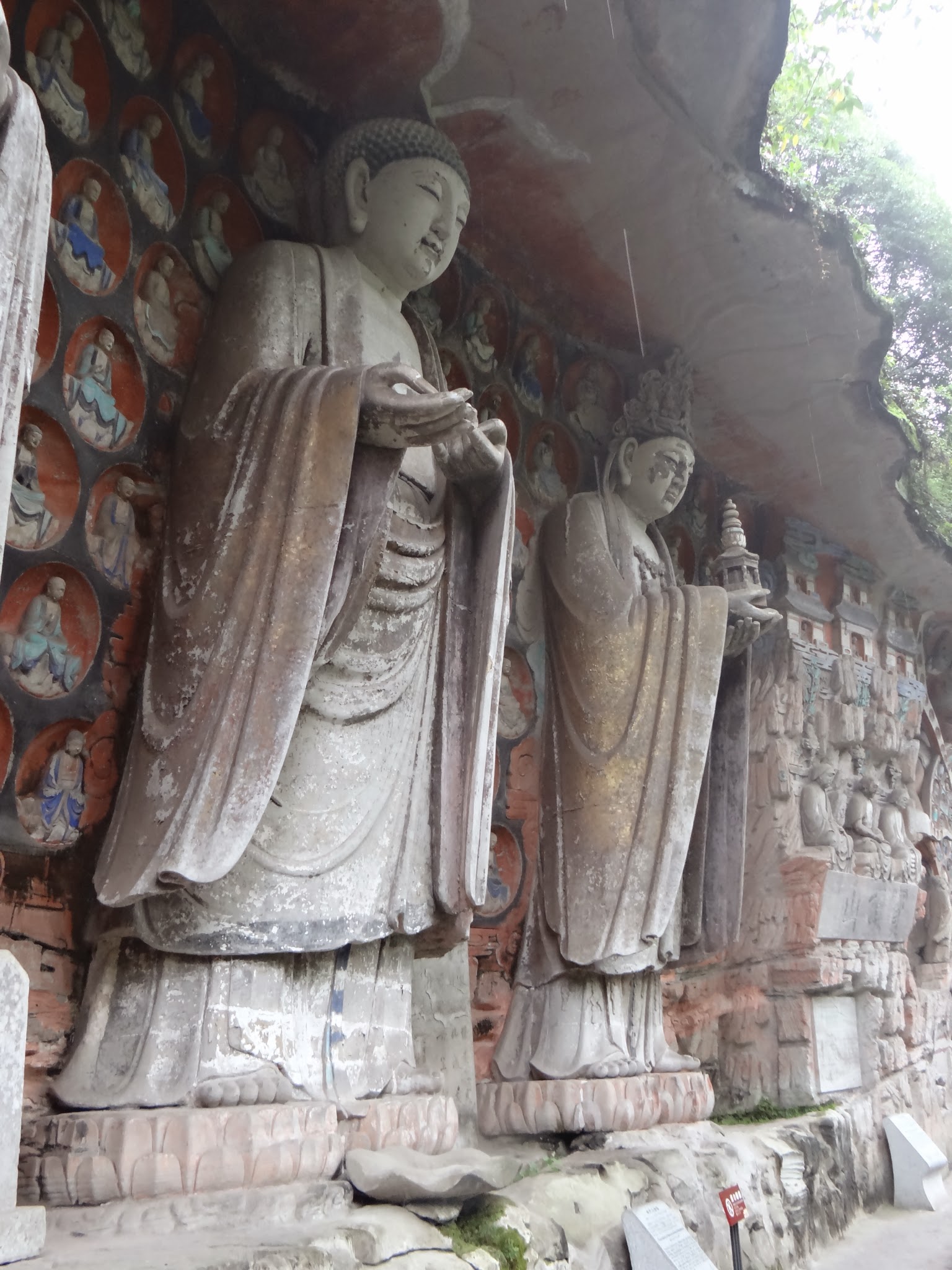
The reason for the early start was that we had a long day ahead of us. Our first stop of the day were the nearby Baoding Shan Caves, a UNESCO heritage site that dates back to the 9th century Tang Dynasty. We were enchanted from the first moment and even though the weather had turned grey and grizzly, this just added to the atmosphere. The early start also helped, because we pretty much had the place to ourselves, before any megaphone wielding tour groups arrived.

The complex started at the 'Treasured Summit' and we slowly descended through rain-forest, until the granite rock sharply dropped away into sheer cliff faces. The path then levelled and curved around to reveal a series of wonderful carvings under the overhangs of the cliffs. The largest was a 31 metre long, 5 metre high reclining Buddha, but there were numerous other Buddhas that towered several metres above us. What was most impressive, bearing in mind their antiquity, was how intricate and well preserved they were and several even had their original paint intact.

The site descended a couple of hundred metres to a valley floor which was cleaved by a clear stream, which we crossed on stone bridges: first looking down from high above, then close enough to feel its spray as it crashed over large boulders. In between, we came across several enchanting temples and pagodas, hidden away. We could easily have spent the day wandering around this site, with numerous peaceful places to stop. We were both taken by the contrast of the contemplative stillness of this place, with today's freneticism and information overload. Where is the time and space in modern life to simply sit and make sense of ourselves and our situations?


Buddhas carved from the rock at Baoding Shan Cave
The Baodang Shan site steps down to the valley floor
The Treasured Summit Pagoda at the cave site

All too soon, we were leaving Baodang Shan, for the 6 hour drive to Chegdu, though we did have a date with some pandas coming up to keep us interested (more on that later). We drove through a mix of mountains, farmland and industry, passing the large industrial city of Chongqing, with its huge factory chimneys belching out smoke and chemicals over the Yangtse valley.

Chengdu is another big city with around 4 million people, but is much cleaner than Chongqing. It also feels quite lively and everyone was looking forward to going out in the evening - there were two birthdays to celebrate, as our Belgian accountant was turning 36. Sadly Sue was exhausted by the past few days and rapidly coming down with a migraine as we arrived and she was the only person not able to come out. I went along for the birthday meal, but felt quite sad when a big birthday cake arrived after dinner, with 'Happy Birthday Kevin and Sue' piped onto it. The cake quickly disintegrated, but I managed to smuggle a couple of chocolate roses back for Sue.

Sue was a little better the next day, which was a free day, but as we were staying in quite a nice room, we seized the opportunity of a lie in to recuperate. Our main activity of the day was to walk for a couple of miles through the city centre to a huge new Carrefour supermarket. Walking through the streets is always the best way to get to see a place and we quite liked Chengdu, despite the usual noise of Chinese streets and the constant peril of being run over. Green lights on pedestrian crossings only seems to be a guide: traffic can, and will, still come at you from all angles and one just has to start crossing the moment there is a gap in the first lane and then dodge between cars, lories, buses etc, playing a kind of game of chicken.

Chengdu traffic following the 'Chinese rules of the road'

The Carrefour supermarket was quite an experience when we got there. Most Chinese supermarkets focus almost exclusively on dried goods, with fresh fruit and meat difficult to come across. Carrefour seem to have come up with a good formula, mixing a standard supermarket with a farmers market. In the fresh goods area, we found large aerified tanks filled with a variety of live fish, which you could chose and have killed and gutted for you on the spot. We also found live crabs and frogs on display: we watched carefully in case one of them hoped into our basket! There was also an amazing variety of fresh fruit and vegetables: we counted more than 20 types of mushrooms for example. Sue, in particular walked wide eyed around the place, which was jammed full of people.

Supermarket shopping - Chinese style

On the way back, we passed a junior school. It was a Friday afternoon and as a treat, the whole school seemed to have been brought out into the playground to watch a clown / magic show. We stopped to watch and, though we had no idea what was going on, it was hugely entertaining just to watch as the children jumped up and down with excitement, laughing, cheering and shouting when prompted. It seems that the future Chinese generation isn't going to be any quieter than the current one!

In the evening, we headed out to an area of traditional hutongs close to our hotel. This was a maze of narrow paths and alleyways, criss-crossing streams and a small lake, with covered stone bridges where courting couples sat, clandestinely holding hands. Dark was falling as we arived and the lanes were lit up by tunnels of glowing red lanterns. The air was filled by the hubbub of the locals out for their Friday evenings, the sounds of music from bars, restaurants and a nearby Buddhist temple and the smells of roasting meats. The whole effect was quite intoxicating and we just walked for a while taking it all in.

Eventually we stopped in a small restaurant that was full of Chinese people. With no means of communicating, we picked 2 random dishes with no idea what would come our way. One was a big bowl of noodles filled with a greasy red oil, chillies and some bones of indeterminate animal origin and was pretty much inedible, the second a plate of stir fried vegetables with rice which kept us going. In any case, it didn't really matter, because we had a prime window seat looking down over the street below.

We will finish this post on the streets of Chengdu. The next day was another big day, taking in the nearby panda sanctuary, the world's largest Buddha and ending in one of China's holiest mountains at Emei Shan. We will let you know how we got on with that in our next post!

And finally...Chinese chickens out for a family picnic at Baodang Shan


Friday, 25 October 2013

Ganja on the Yangtse

On Saturday 12th October, we sadly left Wudang Shan, but looking forward to our upcoming 2 day / 3 night ferry down the Yangtse. We took a brief detour on the way down to see the Purple Heaven Palace, a beautiful Buddhist temple complex, nestled into the forested hillside. It was a good time to see it, coinciding as it did with morning ceremonies and the atmosphere was a heady mix of burning incense, chanting, tinkling of cymbals and the solemn faces of the saffron and burgundy robed monks.

The Purple Heaven Palace on the lower slopes of Wudang Shan

Preparing for the morning mantras at the Purple Heaven Palace
Before getting onto the boat, we had pretty much 2 full days on the road. The first took us through more mountain scenery, eventually descending into fertile agricultural land, with rice paddies cascading down the hillsides. We stopped at a service station for what is becoming our ritual lunchtime stop. We typically get a buffet lunch, with rice and a variety of meat and vegetable dishes, though I use the term meat loosely, because very often it is mostly bone and gristle, swimming in a cocktail of oil and chillies! As we head south and west, the food is getting more and more spicy and we have to watch carefully for the lethal little peppercorns which leave the mouth fizzy and numb: chewing a couple of these would render a trip to the dentist entirely pain free!

In the late afternoon, we arrived in the city of Yichang and our first glimpse of the Yangtse. It is a city of some 4 million people, described as 'drab and hum-drum' by the Lonely Planet. Fortunately, as often, they are off the mark and it turns out to be a good place to spend the night, with a nice promenade along the river, a spectacular new suspension bridge and a lively centre with lots of restaurants, bars and shops. We also have a comfortable, clean, modern hotel for the night which always helps. We mainly spent our time, stocking up with provisions at a large new supermarket. To our delight they stocked things that we hadn't seen since arriving in China, including bread, cheese and coffee.

The next day we had a longer drive then expected, due east to Wanzhou to pick up the ferry. Because of the mountainous terrain, the motorway heads north-east before curving back south east to re-join the river. The main interest, is some of the feats of engineering: long tunnels through the rock and one modern bridge after another, either crossing gorges, or a river. The Chinese must, surely be the great bridge builders of our times.

We eventually arrived and boarded our ferry at after 8pm, for a 9pm sailing and we are in for a pretty tough few days. The boat is a hell hole, rammed with noisy Chinese tourists and us, probably the lowest class ferry still in service on the Yangtse! We shared a cabin with Michelle and Geoff, which was just about big enough for 2 pairs of bunk beds and a filthy squat toilet / shower which reeks - and it would take great courage to use either. We cleaned it the best we could, but to no great effect.

Later that night we noticed a pungent, sweet smell coming from a gap in the wall to next door's cabin (and as we had the end cabin, concluded that it could only be the staff quarters). We quickly realised that this was marijuana. We were not sure whether to be more worried by the state of the boat, or the fact that at least some of the crew were stoned, but at least it overpowered the smell from the toilet and we drifted off into the sweetest of dreams!

In the morning, the boat passed through Qutang, the first of the famous Three Gorges, but the 2 small observation decks are crammed full, each with a Chinese tour guide bellowing into a megaphone and we crouched below deck by a tiny port hole (or should that be pot hole?!) and saw a little of the towering cliff tops slide by the rubbish strewn Yangtse.

In the afternoon, the boat docked for 4 hours and, with most of the rest of our group, we decided to go on a side excursion on a smaller boat up a tributary of The Yangtse, which runs through very similar terrain. The views from the boat were indeed spectacular, with cliff tops towering sharply hundreds of metres above us, punctuated by small farming communities and the occasional stop for tourists. Unfortunately, there was a huge BUT. The smaller boat was just as crammed and came with a Chinese guide who shouted into a microphone incessantly, pausing for breath just once for 5 minutes in each direction. This was relayed on loudspeakers throughout the boat at ear-drum shattering volume and there was no escape from the din. The Chinese loved it and shouted and chered and laughed and took pictures of one another. Poor Sue put her ipod on full volume to try and muffle the noise a little and curled up in a corner to try and insulate herself from it, but the whole experience was quite traumatic for her.

Bizarrely, half way through the trip we stopped at a jetty and were transferred to a series of flat-bottomed gondolas and were punted along into a small cove, whilst a guide dressed up as a mythological creature sung folk songs to us. This sounds like it might be quite enchanting, but even he, on a boat with about 20 people in a serenely quiet spot, needed a microphone to pump up the volume. Just when we thought it couldn't get any stranger, a few more costumes were found and every Chinese person on the boat had to dress up and have their photo taken in return for a few yuan to the guide.

On the second day, the boat docked early in the morning at a peaceful little village. On one side of the pontoon, however was docked a flotilla of gaudily painted dragon boats. Our boat largely emptied in a few minutes and poured onto a series of these to head off on a 2 hour backwater tour. We had learnt our lesson from the previous day's experience and opted out. Instead we wandered into the village, which was quite charming, with lovely views down onto the Yangtse and the mountains beyond. We found a small restaurant and, though they understood no English, managed to get ourselves a tasty breakfast with noodle soup steamed vegetables and baked sweet-potato. This was, at least a small reprieve from the bedlam of the ferry.

In the afternoon, we docked again and were herded off on a series of buses to see the controversial Yangtse Dam. The whole tourist experience is clearly intended to sell the concept of the dam. We are fed a series of statistics about it's huge scale (the largest dam in the world, that will produce vast quantities of clean hydro-electric power etc) and I can't help thinking: 'there are lies, dam lies and statistics'!

We were not allowed onto the dam itself, but instead got taken to a series of arm's-length vista spots. The last was probably the nicest, viewing the dam from below from a newly created park featuring carp-filled ponds, lush vegetation and sculptures crafted from waste materials from the dam construction. We were assigned an English speaking guide, but her English was barely intelligible and she just wanted to bark out a series of statistics into a microphone at us. We managed to detach ourselves from the group, but felt a little sorry for her: our group was like trying to herd cats, compared to the orderly Chinese groups, who dutifully followed their flag-waving guide.

We came away from the tour really none the wiser on whether the dam should be applauded or decried. The sensible conclusion would seem to be that when the dam finally starts to produce its electricity (in 2014) the costs in terms of uprooting communities and other damage, will probably lead to a significant environmental positive.

Back to the boat and we had just one more night to get through, which was basically a non-stop downstream sail back to our starting point. A lot of people had got off, so we passed a quieter evening in the restaurant. All things are relative though and we were jointed at one point by some high-spirited Chinese guys who were on a holiday. We did a number of 'Gambeis' (formal toasts) with them, as they were determined that we tried their home-brewed, 12 year old rice wine. This was surprisingly smooth and we had a fun half-hour with them, though neither of us had any idea what the other was saying, much as our guide struggled to translate!

We arrived back to a rainy Wanzhou early the next morning, all pretty much bedraggled and worn-out by the experience. Time will tell whether we will look back on this as an unforgettable and privileged close-up experience of Chinese culture, but for the moment, it just feels like we sailed for 2 days, 3 nights through paradise spoiled.

Here are some pictures to give you a flavour

A view of our boat, during our peaceful interlude on the 2nd morning aboard
Our cabin toilet on the Yangste - only for the brave or need


The Qutang Gorge on the Yangtse
A scene from the Yangtse tributary (but we couldn't photograph the noise!)
Some Yangtse Kitsch - all aboard the dragon boats!
The Yangtse Dam from above.....
... And below
And finally...fresh Yangtse fish anyone?